
Reviewed 2026-10-26
How to Choose Wedding Table Centerpieces
By Samudra · Updated
Short answer
Here is how to choose wedding table centerpieces: measure your tables, place the full dinner setting, and choose an arrangement that fits the space left for decoration. Test guest sightlines from actual seats, match the flowers and materials to your venue, and price every table plus delivery, setup and removal. Use low designs where conversation and serving space matter most; choose tall arrangements only when guests can see beneath them and the supports are stable. Approve one complete sample before ordering the rest.
| Your table or priority | Start with | Check before ordering |
|---|---|---|
| Small table or limited spare space | One compact low arrangement or a few small vessels. | Full place settings fit without pushing flowers into glasses or plates. |
| Round table with plated service | A low central bowl, a small cluster, or a tall open stand. | Guests can see across the table and the number remains visible. |
| Long or narrow banquet table | Repeated small arrangements with deliberate gaps. | The usable center strip fits decorations and any shared food. |
| Family-style meal with shared platters | Small movable pieces or very restrained decoration. | Actual platters and serving utensils have reserved spaces. |
| Large room needing visual height | Selected tall arrangements mixed with lower designs. | Stable supports, venue clearance and seated views work on every affected table. |
| A floral-free or flame-free plan | Battery-lit lanterns, sculptural objects or low foliage. | The object’s opaque sides, footprint and setup costs suit dining use. |
1. Measure the table and set the meal before choosing flowers
Get the rental or venue specification for every table type. Record the diameter of round tables and the width and length of rectangular ones. “Banquet table” describes a use, not a guaranteed width. Two tables with the same length can leave very different amounts of space between facing place settings.
Next, confirm the guest count per table and meal format. A plated dinner, buffet and family-style meal use the tabletop differently. Even at a buffet, guests return with plates and need somewhere to put them. For shared food, reserve places for actual platters, bread, condiments and serving utensils before adding decoration.
A useful way to estimate wedding centerpiece sizes
Set one real place setting, including the largest plate or charger, cutlery and every glass that will be present together. Measure how far it reaches inward from the table edge. On a round table, subtract twice that depth from the diameter. On a rectangular table, subtract the depth used on each long side from the width. The remainder is an initial center area to test, not a guaranteed space for flowers.
Illustrative space calculation
60-inch round: 60 − 18 − 18 = 24 inches of central diameter.
30-inch-wide rectangle: 30 − 12 − 12 = 6 inches of central width.
These place-setting depths are hypothetical measurements, not spacing standards. The 6-inch strip may be too tight for your intended design. Change the arrangement, table width or meal setup rather than squeezing guests’ settings to make it fit.
Mark the remaining area with removable tape on a test surface or a paper plan. Add the table number, water bottles and any shared items. Measure the flowers at their widest point, including trailing greenery, rather than only measuring the vase base. A narrow vessel can support a very wide arrangement.
Centerpieces for round wedding tables
A round table benefits from a design that looks finished on every side. Start with one central focal arrangement or a compact group of smaller pieces. Check it from each seat, because an attractive front with a bulky back does not work for guests sitting around it. Avoid spreading extra candles and signs so far outward that they invade individual settings.
Rectangular, banquet and joined long tables
Repeat smaller arrangements along the available center strip. Leave intentional gaps for shared dishes, table markers and service. A continuous garland can look generous while consuming the whole surface; it is not automatically the most practical or cheapest choice. When tables join end to end, draw the complete run so clusters do not accidentally double up at each join. Check guests seated at the ends as well as along the sides.
2. Choose wedding centerpiece height by testing seated sightlines
Test the finished design at the actual table and chair height. Ask people of different heights to sit opposite one another and in diagonal seats. Include the needs of the guests who will use the table, including wheelchair users where relevant. Can they see each other’s faces without leaning around the arrangement? Can they see the couple or speaker when that matters to the room plan?
For a low arrangement, the flowers should sit below those views. For a tall arrangement, the dense flower head and hanging foliage must sit above them, with an open view beneath. A tall vase is not enough if flowers cascade into eye level. Clear glass can still contain dense stems, reflections or water lines that interrupt the view.
Florists often discuss low and elevated options, but published height ranges vary. Fiore Designs’ guidance also emphasizes sightlines and width. Treat measurements as a starting proposal to test, not a rule that guarantees comfort. Record both total height and the lowest point of any overhead flowers; those describe different things.
| Option | Advantages and suitable settings | Limitations to resolve |
|---|---|---|
| Low arrangement | Close-up detail; often suits intimate rooms, conversation-focused dinners and lower ceilings. | Wide flowers can crowd place settings. Dense designs may still use many stems. |
| Tall arrangement on an open support | Adds height in a large room and can leave space around a narrow base. | Needs a clear view beneath flowers, stable construction, careful transport and venue approval. |
| A planned mix | Adds variety and lets each table shape use a suitable design. | Requires separate samples, quantities and a placement map; do not block key views with tall pieces. |
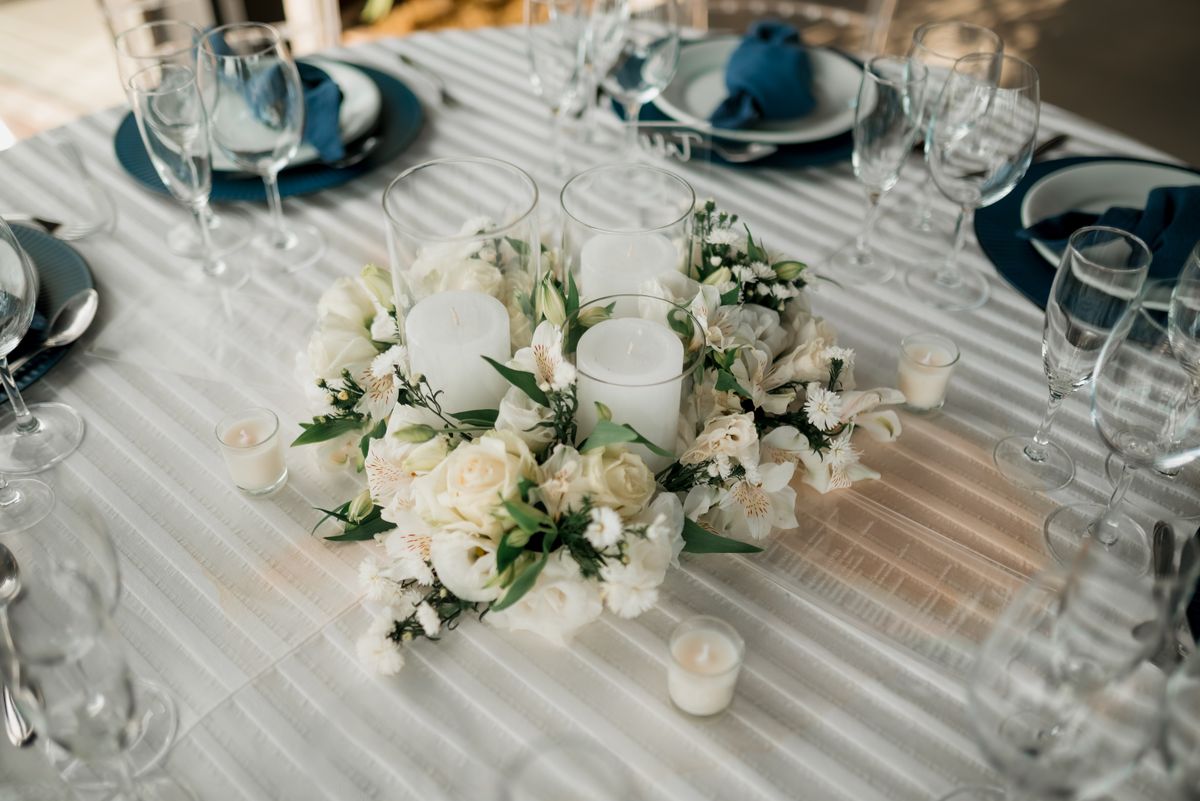
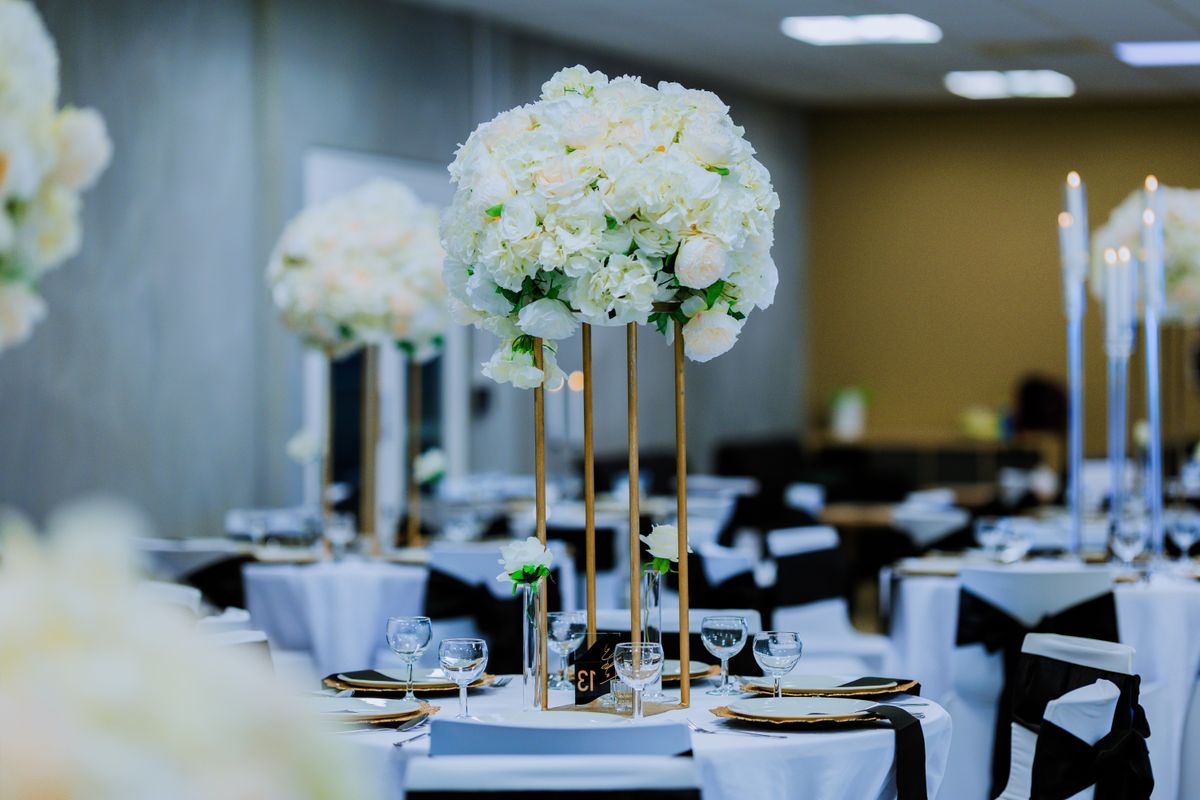
When comparing wedding centerpiece height, photograph the mockup from seated eye level, not just from above. A standing photograph can hide the exact obstruction your guests would face for the entire meal. Keep the approved image with the florist’s order sheet.
3. Choose materials and wedding table centerpiece ideas that fit the room
Shortlist wedding table centerpiece ideas that suit the venue’s fixed colors, ceiling height, lighting and furniture. Bring fabric and paper samples to the mockup. White flowers, cream linen and warm candlelight may read differently together than they do in separate online photos. Check a sample in evening light if that is when guests will dine.
Repeat a small number of materials to connect the design: glass and soft flowers for an airy setting, ceramic bowls and textured linen for a relaxed dinner, or a restrained metallic finish for a formal room. Let one element carry the detail. Patterned linen, elaborate plates and a dense arrangement do not all need to compete for attention.
| Material or format | A useful design idea | Cost or practical tradeoff |
|---|---|---|
| Fresh flowers | Low garden-style bowls or a sculptural arrangement in a simple vessel. | Price depends on varieties, quantities, availability, labor and mechanics. Agree substitutions. |
| Greenery | Short foliage sections with visible gaps on a long table. | Dense garlands can require substantial material and labor; check shedding and tabletop width. |
| Bud vases | A few stems in repeated small vessels for a light, colorful look. | Fewer stems per vase can help, but many vessels add washing, filling, packing and placement time. |
| Candles | A small group of holders with battery candles for evening light. | Include holders, batteries or candle replacement, setup and cleaning; confirm venue rules. |
| Lanterns | One stable lantern as the main object, with a visible table marker. | Opaque frames can obstruct faces. Check the base size and use the appropriate light source. |
| Non-floral objects | Low ceramic pieces, framed illustrations or contained fruit displays. | Keep sharp, loose or rolling pieces off dining space; confirm food handling and venue permissions. |
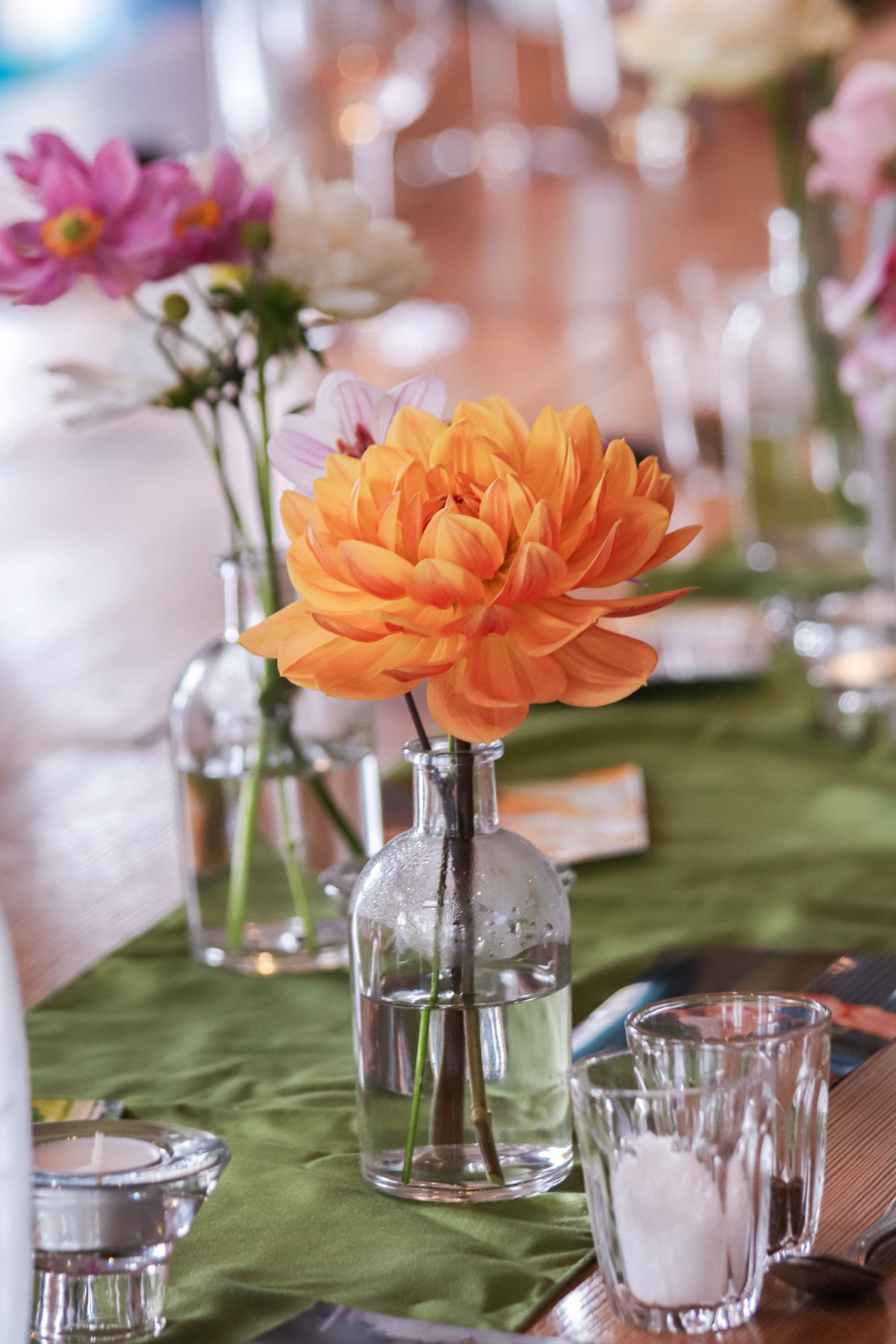
Minimal: bud vases with room to breathe
For a modern or relaxed table, choose small vessels with a limited flower palette. Repetition provides continuity without covering every inch. This works well when place settings already have color or the room has strong architecture. Ask for the total assembled price: dozens of individually styled vases can be labor-intensive.
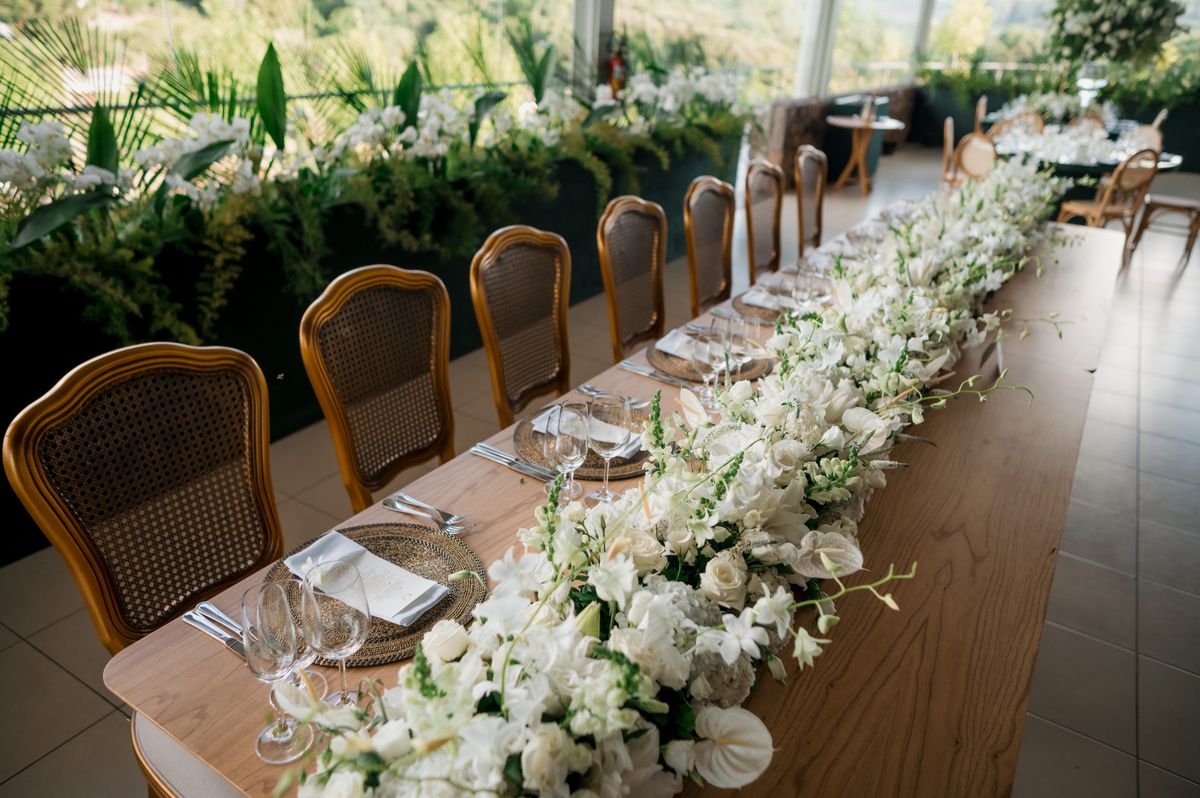
Elaborate: a floral runner on a wide long table
A full floral runner can suit a generous table width and plated service. Ask the florist to specify finished width, how the flowers receive water and how the installation is divided for transport. Keep paper and extra ornaments restrained. If the same table needs family-style platters, choose separated sections or change the design.
Non-floral: a lantern as the focal piece
A lantern can suit a rustic room or an evening reception without fresh flowers. Match its footprint to the available table area and test the solid frame at eye level. For an uncluttered version, use a battery candle inside and a readable table number beside it. Do not assume decorative lanterns are approved for real flames.
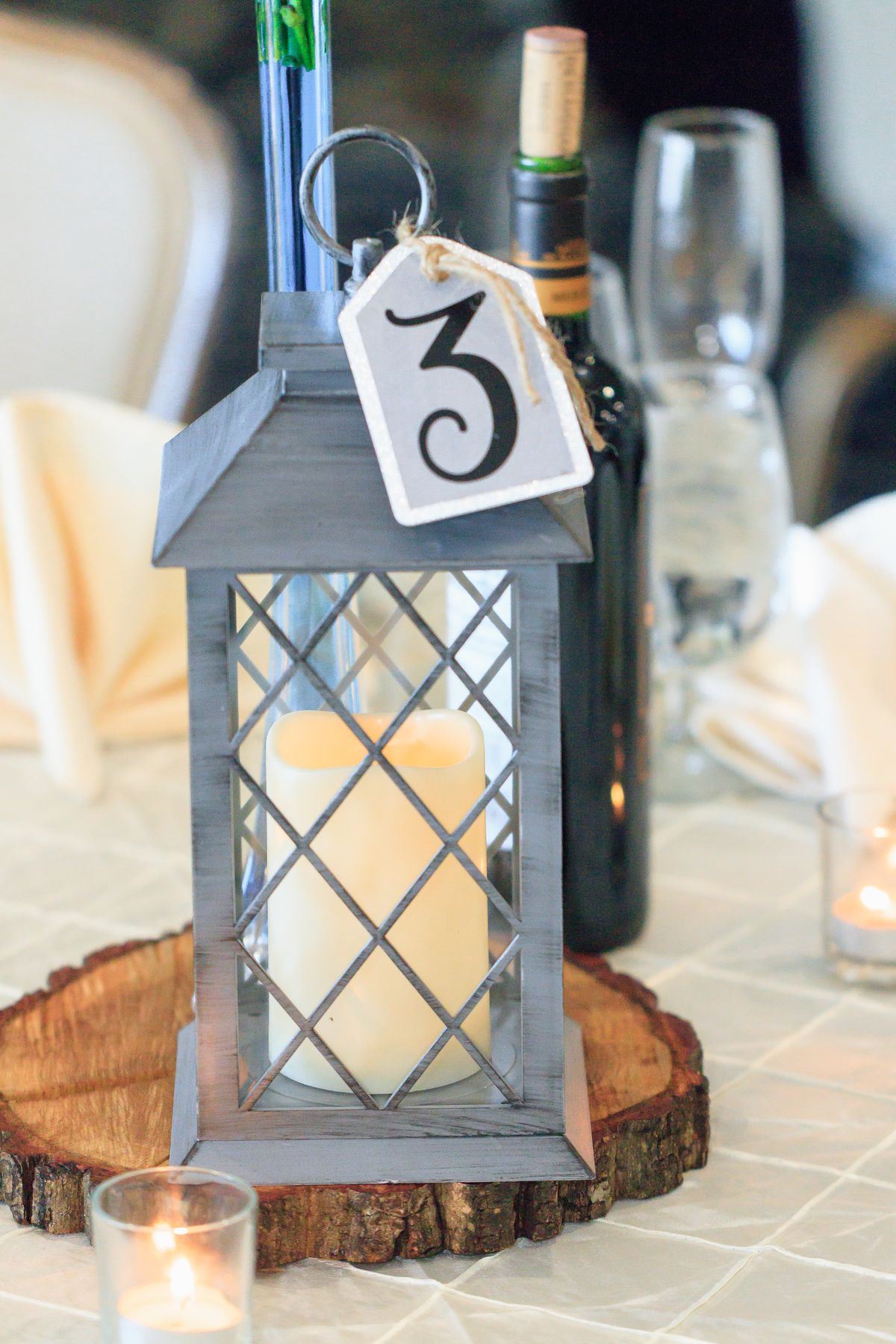
These are licensed stock examples, not WeddingPhoto App client installations. Use them to compare form and space, not to infer dimensions, prices or compliance. The photos are used under the Pexels license; each links to its photographer’s source page.
4. Test four practical table layouts
The following are hypothetical starting layouts. They show how to reason about wedding centerpiece sizes without declaring a fixed table-to-flower ratio. Your venue must confirm seating and service space for the actual furniture.
A small, intimate dinner table
For a 36-inch round table planned for a small group, begin with the complete dinner settings and one compact low bowl. If even that crowds the glasses, use a single small vessel or move the decorative feature away from the dining surface. Avoid a wide tray holding several objects: the tray can consume more usable area than the flowers.
A 60-inch round reception table
For an illustrative eight-place setup, test a low central arrangement inside the measured center area, then add the table number and water service. Check each seat before adding candles. Centerpieces for round wedding tables should remain balanced from every direction, but they do not need to fill the whole center. If a dense design interrupts conversation, reduce its width or height before increasing the vase size.
A long banquet table
On a 96-by-30-inch table, the width is likely to constrain the design more than the length. Start a mockup with three small clusters, then adjust their size and position around the actual settings and shared items. Three is a test choice, not a required count. For family-style service, put the real platters down first; if little center space remains, use fewer objects or ask about a wider table.
A large reception room with mixed table sizes
Use the room plan to decide where height adds something. Selected tall arrangements can create emphasis while lower designs keep important views open. Mark the couple’s table, speeches, screens and guest paths before placing tall pieces. Coordinate one palette across both versions, and quote each version separately. A big room does not require every table to hold the biggest possible arrangement.
Use the wedding seating chart tool to organize guest groups, then confirm the physical floor plan with the venue. It is the actual table layout and service plan that determine the centerpiece quantities and sizes.
5. Coordinate flowers with plates, glassware and stationery
Wedding reception table centerpieces are one part of a set table. Confirm which glasses stay for the whole dinner and which arrive with a course. Include the menu, place card, bread plate, water and table number in the mockup. A table that works before service can become crowded when the first course arrives.
Use a few consistent colors and textures, then leave empty space between objects. If you choose richly patterned plates, a simpler vessel may be enough. If the flowers are very detailed, plain menus can be easier to read. Check that the table number is visible from the aisle and place cards can be read without moving a glass or touching flowers. Our wedding stationery checklist helps decide which paper pieces you actually need.
Ask for low-fragrance choices near food and a plan for flowers that shed pollen or petals. Tell the florist about known guest sensitivities rather than assuming any flower is suitable for everyone. Avoid loose glitter and scattered pieces that staff must clear before setting down a plate.
6. Calculate the complete wedding centerpiece budget
Count the actual tables receiving decoration, then the arrangements on each table. Ten round tables with one bowl each mean ten arrangements. Four long tables with three clusters each mean twelve clusters, even though there are only four tables. Add head, sweetheart, welcome or cake-table pieces only if they are part of the order.
Total centerpiece cost = all quantities × their unit prices, added together, plus separately charged vessels, delivery, setup, removal, fees and taxes.Keep a refundable rental deposit separate from the eventual cost, but include it in the cash you need available. Ask which services are already included so you do not count them twice.
Worked example: 14 dining tables with two designs
These USD amounts are invented to demonstrate the calculation, not market prices or supplier quotes. Assume the arrangement prices include their vessels. The example’s 8% tax applies to the whole $1,800 subtotal only for this arithmetic exercise; actual tax rates and taxable items depend on the seller and location.
| Item | Calculation | Example cost |
|---|---|---|
| Low arrangements for 10 round tables | 10 × $75 | $750 |
| Three bud-vase clusters on each of 4 long tables | 4 × 3 × $35 | $420 |
| Battery-candle sets for 14 tables | 14 × $10 | $140 |
| Delivery | One agreed delivery | $120 |
| Setup and removal | One agreed labor allowance | $250 |
| Sample supplies | One trial allowance | $120 |
| Subtotal | $750 + $420 + $140 + $120 + $250 + $120 | $1,800 |
| Hypothetical tax | $1,800 × 8% | $144 |
| Planned cost | $1,800 + $144 | $1,944 |
| Separate change reserve | Chosen allowance, not an automatic fee | $200 |
| Budget to set aside | $1,944 + $200 | $2,144 |
The planned cost averages about $139 per dining table, but neither design costs exactly that amount. Keep the individual quantities so you can adjust them when seating changes. If the supplier also requires a refundable $200 deposit, this example would need $2,344 available initially, including the reserve. The deposit is recoverable only under the agreed return terms.
Reduce cost without creating extra work you cannot cover
Ask the florist to price a simpler design using available flowers and reusable vessels. Seasonal or local options may help, but availability and cost still need a quote. Compare renting against buying after including cleaning, packing and returns. For DIY, time one complete sample from unpacking to a finished table and multiply by the table count. Add transport and cleanup before calling it a saving.
Set the wedding centerpiece budget before approving every inspiration photo. If the quote is too high, reduce design complexity or the number of separate objects. Keep the labor needed to deliver the chosen result. For centerpieces within a larger premium event, the luxury wedding planning guide shows how to weigh design spending against hospitality and the rest of the wedding.
7. Confirm venue rules, stability and setup responsibilities
Get the venue’s decoration policy before buying candles or tall stands. Ask about open flames, required holders, permitted materials, hanging installations, table protection and removal. A glass cylinder or lantern is not automatic permission to use a flame. Have the venue assess the complete design, including foliage and paper.
The U.S. Fire Administration advises stable candleholders, at least 12 inches between lit candles and anything that burns, and considering battery-operated alternatives. This is general fire-safety advice, not a substitute for your venue’s event rules or local requirements. If your crowded tables cannot provide safe spacing, choose battery candles. Assign someone to manage any approved real candles throughout use and extinguish them afterward.
Ask the florist or rental supplier to assess the assembled piece for stability, including flower weight, base, table surface and outdoor wind. Do not improvise a tall support from untested stacked objects. Keep arrangements clear of chair movement and service routes. Consider children’s reach, trailing fabric and guests using mobility aids when reviewing the complete setup.
Give the setup team an approval card
Record the table type, arrangement count, dimensions, photograph, table-marker position and any candle instructions. Name who delivers, fills containers, places each piece and inspects the room. Confirm access time and whether flowers can be kept in suitable conditions before installation. Give a separate person responsibility for packing and rental returns after the party.
Common centerpiece mistakes and the fix
- Ordering from an empty-table photo: build the complete meal setting before choosing the final footprint.
- Measuring only the vase: record finished width, total height and the lowest hanging foliage.
- Assuming tall means unobstructed: sit across from the sample and inspect supports and flower heads from several seats.
- Adding every decorative idea: remove objects until numbers, menus, water and service all work without moving the centerpiece.
- Pricing flowers but not delivery: request the installed and removed total, including containers, labor, fees and taxes.
- Planning an unrealistic room change: reuse flowers only when a named team has the time, route and equipment to move them.
- Leaving cleanup to whoever remains: assign packing and returns in advance so borrowed or rented pieces are not taken home by mistake.
Wedding centerpiece selection checklist
Take this checklist to your florist or venue appointment. Copy, download or print it with a blank sample-table approval card. Keep one card for each design so table quantities, dimensions and prices stay connected when the seating plan changes.
Measure before choosing
- Record every table shape, diameter or length and width, and the number of each type.
- Confirm guest seating and the meal format with the venue and caterer.
- Lay out real plates, glassware, menus, table markers and any shared serving dishes.
- Measure the remaining decoration space, including the arrangement’s foliage overhang.
- Check room features, evening light, outdoor exposure and venue decoration restrictions.
Approve the sample
- Choose low, tall or mixed arrangements based on a seated view test, not vase height alone.
- Check eye contact from opposite and diagonal seats, plus the view toward speeches.
- Confirm the base, finished width, total height and lowest hanging flowers or branches.
- Ask the florist to assess stability, scent, shedding and suitability for the event conditions.
- Have the caterer confirm serving space and staff access around the sample table.
- Get written candle approval; use battery candles if the design cannot meet the venue’s rules.
- Photograph the approved table from above and seated height, with dimensions recorded.
Price the complete order
- Count arrangements or clusters per table, including head, sweetheart and other selected tables.
- List flowers, containers, stands, candles, holders and any separately charged components.
- Confirm delivery, setup, removal, cleaning, taxes, service fees and rental return terms.
- Separate refundable deposits from the final cost and record when the money is due back.
- Approve acceptable flower substitutions and the last date for changing table quantities.
- Keep a separate reserve for agreed replacements or changes, based on actual risks.
Set up and hand over
- Label packed pieces by table and include the setup photograph and quantity list.
- Assign delivery, water checks, installation, candle operation and final inspection.
- Check table numbers and place cards remain readable after flowers and glasses are placed.
- Confirm arrangements do not obstruct guest routes, chair movement or service access.
- Identify which containers may leave with guests and which must be returned to the supplier.
- Assign breakdown, packing, rubbish removal and rental collection after the reception.
Frequently asked questions
How tall should wedding table centerpieces be?
Choose the finished arrangement height by testing it at the actual table and chair height. A low arrangement should let seated guests see over it; a tall one should leave a clear view beneath the flowers. Include the vase, branches and hanging foliage in the test. There is no single height that works for every guest and table.
What size centerpiece works on a 60-inch round wedding table?
Start by setting the table for the planned number of guests. In our illustrative layout, reserving 18 inches inward from each edge leaves a 24-inch central diameter; that is a test area for all decorations, not a recommended arrangement diameter. Glassware, shared food and foliage can reduce it further. Approve the actual sample with your caterer.
Are low centerpieces always cheaper than tall ones?
No. A dense low arrangement can use more flowers than a light design on a tall stand. Tall pieces may add stand rental, transport, assembly and stability requirements. Compare complete installed prices for the same number of tables instead of assuming height determines the cost.
Do all wedding reception table centerpieces have to match?
No. Keep a common palette or material and vary the shape for each table type. For example, use low bowls on small rounds and spaced bud vases on long tables. Give every table a considered design, and approve each version for sightlines and service.
How many bud vases do we need per table?
Count them using a full-size trial. Arrange the place settings and serving dishes first, then add small groups where space remains. Record the number for each table type and multiply by the final table count. A long narrow table and a wide round table should not automatically receive the same number.
Can we use candles instead of flowers?
Yes. Candleholders or lanterns can be the main feature if they fit the table and venue rules. Battery candles avoid an open flame, but still need stable placement and a battery check. Real candles require explicit venue approval, appropriate holders, safe separation from combustible materials and an assigned person to manage them.
Can we reuse ceremony flowers as centerpieces?
Sometimes. Confirm that their containers, height and width suit dining tables, and assign transport and placement during a realistic gap. Include labor and any redesign costs. Do not rely on moving heavy installations through guests or asking the wedding party to rebuild arrangements during drinks.
Should guests take the centerpieces home?
Only if you and the supplier agree. Rental vessels and stands need to return, even when the flowers are yours to give away. Tell the coordinator which pieces may leave and provide a safe way to carry them. Otherwise, leave a clear collection and return plan.
Our product details: features and limits · current plans. Corrections: support@folded.cloud.